If your organization has ever wanted to move to Atlassian Cloud but got stopped by a security policy or a risk team uncomfortable with shared infrastructure, Atlassian has some news for you.
On June 29, 2026, Atlassian announced that Atlassian Isolated Cloud is now generally available: a new way to run Jira, Confluence, and Jira Service Management in the cloud, built for organizations that need more control and separation than standard cloud plans offer.
This is a genuinely different deployment model, one that opens the door to cloud for teams who previously felt cloud just wasn’t an option.
What is Atlassian Isolated Cloud?
In plain terms, Atlassian Isolated Cloud gives your organization its own dedicated slice of cloud infrastructure, instead of sharing space with other customers.
Most cloud software, including standard Atlassian Cloud, runs on a multi-tenant model. Many customers share the same underlying systems, with logical walls keeping everyone’s data separate. It’s efficient and secure, and it works well for most organizations.
But some organizations, especially in regulated industries or under strict internal security policies, need something stricter than “logically separate.” They need physical separation too. That’s what Isolated Cloud provides.
Here’s what you get:
- A dedicated environment, with compute, storage, and networking provisioned just for you
- Data egress blocked by default, so nothing leaves your environment unless you decide it should
- Customer-managed encryption keys, giving you control over what protects your data at rest
- Everything from Cloud Enterprise, plus Atlassian Guard Premium, so isolation doesn’t cost you capability
Think of it as a private, single-customer version of Atlassian Cloud, built for organizations where “good enough” security isn’t good enough.
How AIC works under the hood
You don’t need to be a cloud architect to follow this. Atlassian splits its infrastructure into two layers:
-
The customer data plane. Where your actual data lives: your Jira issues, Confluence pages, projects. In Isolated Cloud, this layer is entirely yours, with its own dedicated network (a Virtual Private Cloud), firewall, domain, and resources.
-
The control plane. The shared machinery Atlassian uses to build and run everything, including your isolated environment. It’s shared across all Isolated Cloud and standard Cloud customers, but it never touches your actual content.
One distinction worth knowing: Isolated Cloud is technically “single-tenant,” but its real design goal is single-customer. One organization can run several tenants inside their own Isolated Cloud, handy for multiple business units, without ever mixing with another Atlassian customer.
The result: fewer shared services means less risk of one customer’s activity affecting another’s performance, plus tighter control over what data moves in or out.
→ Learn about Atlassian Isolated Cloud
Data residency in Atlassian Isolated Cloud
If you’ve looked into data residency on standard Atlassian Cloud before, Isolated Cloud handles it differently, and more simply.
On Commercial Cloud, residency is something you configure: you choose which in-scope data gets “pinned” to a region, and that only covers data at rest.
With Isolated Cloud, residency isn’t a setting. It’s built into the environment. When your instance is created, it’s provisioned in a specific region, and from then on, almost all your data, at rest and in transit, stays within that region. There’s no separate configuration step; you just pick your region up front, and your instance stays tied to it.
That “in transit” part matters. On standard Cloud, only data sitting still for 30+ days is covered. With Isolated Cloud, even data moving between systems as your team works stays inside the boundary. For organizations with strict data sovereignty needs, that’s a real upgrade, not just a technicality.
One honest caveat: Atlassian staff may still access your content for support, but only with your consent or when genuinely necessary to resolve a major incident. It’s not zero-access. It’s tightly controlled.
Is Atlassian Isolated Cloud right for your organization?
Isolated Cloud isn’t for everyone, by design. A simple way to think about fit:
Probably a good fit if:
- Your security team has ruled out multi-tenant cloud entirely
- You’re in a regulated industry with strict data isolation requirements
- You’ve stayed on Data Center because cloud never felt secure enough
- You need customer-managed keys and tight control over data egress
Might be more than you need if:
- Standard Cloud with data residency and Guard Premium already meets your bar
- You depend on apps or features not yet supported here
- Your team relies on Rovo, Atlassian Intelligence, Bitbucket, or Trello daily
That last point deserves honesty. Isolated Cloud launched with Jira, Confluence, Jira Service Management, and Guard Standard and Premium. More apps and capabilities, including Rovo, are coming, but they’re not here yet. If your team can’t function without AI features or Bitbucket today, it’s worth checking Atlassian’s roadmap before committing.
For everyone else needing strong isolation who can work within today’s feature set, Isolated Cloud is a solid option, not a compromise.
→ Apps and features available for Atlassian Isolated Cloud
Extend Isolated Cloud with DevSamurai Apps
Here’s good news for teams already relying on DevSamurai apps: you don’t have to choose between strong data isolation and the tools your team already knows.
Isolated Cloud supports third-party apps through a dedicated Isolated Cloud Marketplace collection, and we’re happy to share that GanttTable is our first app available on Isolated Cloud. If your organization is moving to this new environment and relies on GanttTable for project planning and scheduling in Jira, you can bring it along without missing a beat.
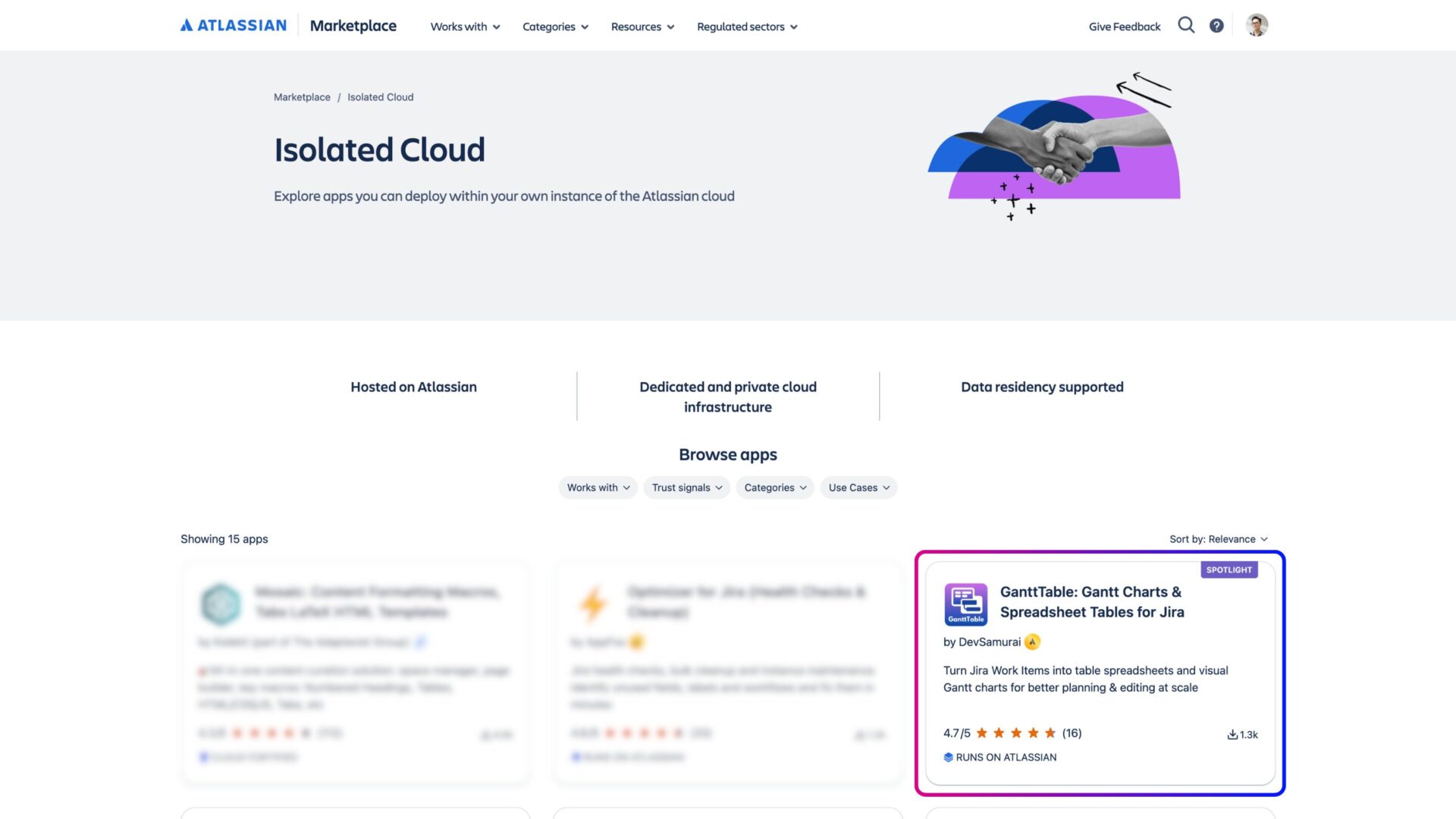
This is just the start. We’re actively working on bringing more DevSamurai apps to Isolated Cloud, so teams won’t have to choose between strong data isolation and the broader toolset they depend on.
If you’re planning a move to Isolated Cloud and want to know more about GanttTable’s availability there, or want a heads-up when more of our apps join it, our team can walk you through it.
→ Schedule a GanttTable demo with our team
Closing
Atlassian Isolated Cloud is a meaningful new option for organizations that have been waiting for cloud to catch up to their security requirements. It offers real physical isolation, tighter data residency guarantees, and enough overlap with Cloud Enterprise that you’re not starting from zero.
It’s still early days. Some apps and AI features haven’t landed yet, so it’s worth checking the fit for your needs before committing. But for organizations stuck choosing between “secure” and “cloud,” Isolated Cloud finally offers a real path forward, without giving up the tools you already depend on.
Have questions about moving your Atlassian setup, including your DevSamurai apps, to Isolated Cloud? Reach out to our team, and we’ll help you find the right path.