How persona mapping and visual planning for product development operate natively within the protected boundary of Atlassian Isolated Cloud.
Product development in Jira often depends on more than Jira alone. Teams use apps to map user stories, build personas, plan roadmaps, and organize releases. But in a security-conscious cloud environment, those workflows raise an important question: does any product data leave the Atlassian environment?
That matters most for teams moving from Data Center to Atlassian Isolated Cloud, where every app has to meet stricter expectations around where data is stored and processed.
The challenge is clear. Product teams still need rich, visual planning tools, while security teams need confidence that sensitive roadmap, persona, and planning data stays inside the secure boundary. Fortunately, those goals do not have to conflict.
What is data egress?
The term “data egress” sounds technical, but the idea is straightforward. It refers to data leaving an environment you control and being sent to infrastructure you do not own or manage.
For many apps, that is part of how the product works. A user may enter a story, add customer information, or write a roadmap note, and the app can send a copy to the vendor’s cloud for storage or processing. Once that happens, the copy exists outside your controlled environment.
Usually, this happens quietly, in the background, where you never see it. That invisibility is exactly why security teams worry. Think of it like sensitive documents being photocopied and mailed somewhere you can’t watch: even if the vendor is completely trustworthy, you’ve lost sight of where your information is.
Not every app works this way, though. Some are built to keep your data within the Atlassian environment, so nothing is shipped to a separate vendor system in the first place. The difference isn’t always obvious from the outside, which is why it’s worth asking about before you install anything.
Why this matters to regulated teams, and how Isolated Cloud responds
For some organizations, external data movement is more than a general security concern. It can become a compliance issue.
Teams in finance, healthcare, defense, government, and critical infrastructure operate under strict rules governing where their data can reside. When information quietly moves to an outside server, it can break those rules and make it hard to prove where data sits, and proving it is often the whole point.
This is one reason Marketplace apps are often blocked or subjected to extensive review. Security teams can’t sign off on something that opens an invisible door. Many of these organizations stayed on Data Center for years precisely because it gave them that level of control. The challenge now is moving to the cloud without surrendering it.
Atlassian Isolated Cloud is designed to address that requirement at the platform level, before individual apps are considered.
Because the perimeter is sealed this way, the app question changes. It’s no longer “will this app leak our data?” but simply “does this app work inside the boundary?” ProductGo is built for that requirement.
ProductGo: Agile planning that never leaves the boundary
ProductGo brings visual Agile planning for product development right into Jira: user story mapping, persona management, and roadmap planning, all in one place. In Isolated Cloud, it does that work inside your secure environment rather than on an outside server you have to trust and track.
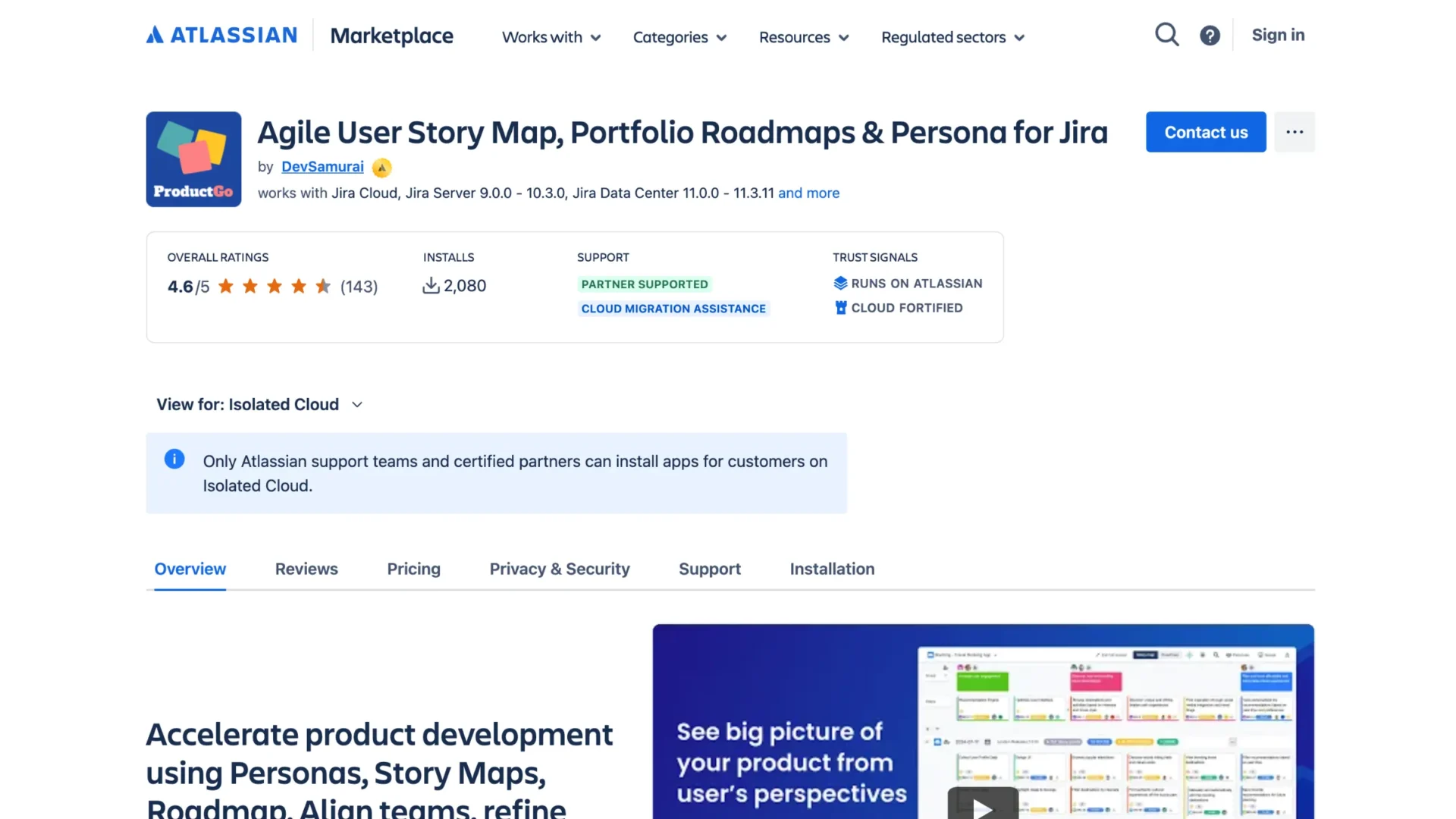
ProductGo is built on Atlassian Forge and has Atlassian’s “Runs on Atlassian” designation, so it relies only on Atlassian-hosted compute and storage.
In practical terms, ProductGo story maps, personas, and roadmaps are stored and processed inside the same Atlassian environment as your Jira data. They remain within the same trust boundary and follow the same data-residency controls. ProductGo does not need to send that information to DevSamurai-owned servers in order to work.
For the product team, that’s no compromise at all. It’s the same visual capabilities they’d expect. For the security team, it’s simply one less door to watch. Both sides can get what they need without treating usability and security as competing priorities.
The same features, seen through a security lens
The main benefit is that “secure” no longer has to mean “less capable.” Looking at ProductGo feature by feature makes that clearer.
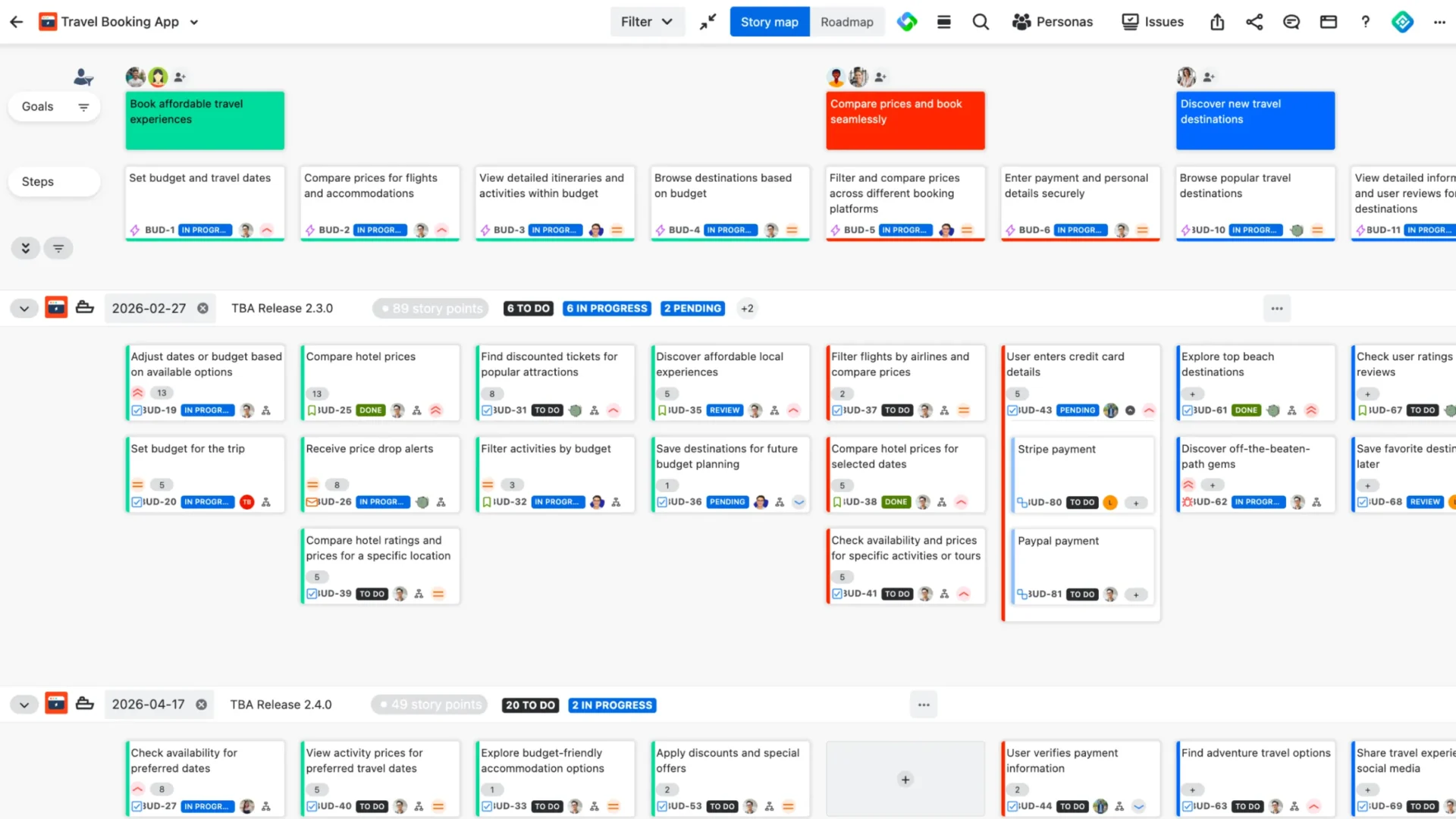
- Visual story mapping. ProductGo breaks you out of the flat backlog, laying out your product as a clear map of the user’s journey, with a goal layer on top of Jira epics for multi-level planning. Teams can identify gaps, prioritize product development work, and plan releases with the broader picture visible.
- Persona mapping. Create detailed user personas, then attach them to goals and issues so the team stays focused on real users. This is genuinely sensitive context: who your customers are and what they need. In Isolated Cloud, it stays within your boundary instead of traveling somewhere you can’t see.
- Roadmaps and release planning. Plan and track your timeline with milestones, and organize work by release or sprint. Because roadmaps reveal your strategy, keeping them in-boundary protects more than just data; it protects your plans.
- Portfolio views. Combine multiple projects into flexible boards for cross-team planning, still entirely within your isolated environment.
- Sharing where your team works. Surface your story maps and roadmaps in Confluence, so stakeholders see the plan without anyone exporting it to an outside tool. The plan travels to your team, not past your walls.
A useful practice when evaluating any app for Isolated Cloud is to ask where each capability stores and processes its data. With ProductGo, that answer remains simple: inside the environment.
A shared advantage for product and security teams
Step back, and the picture is refreshingly clear.
The product team keeps everything: visual story maps, personas, roadmaps, and portfolio planning, with no stripped-down “secure version” and no features quietly left behind. The security team, meanwhile, gains real peace of mind: no new path for data to escape, no extra audit surface, and no exception to sign off on.
The idea that secure software must be less capable was never unavoidable. It largely came from how many applications were architected. Apps built specifically to operate in Isolated Cloud, including ProductGo, change that relationship.
There is still one practical point to keep in mind. The Isolated Cloud app catalog is continuing to grow because every app has to be built specifically for this environment. App availability therefore remains something teams should check during planning. ProductGo already being ready for Isolated Cloud gives organizations a meaningful head start.
→ What Atlassian Isolated Cloud Means for Marketplace Vendors
Next steps
The key point is simple: Isolated Cloud does not force you to choose between protecting your data and giving teams the tools they need for product development. With ProductGo, you can have both.
If you work on the product side, the most direct next step is to see how ProductGo works in practice. You can try it in your environment, book a demo, or explore the sandbox.
If you are responsible for security, take the opposite approach. Review ProductGo’s architecture and data-handling model, then confirm for yourself that it meets your organization’s requirements. A tool designed for secure environments should be able to withstand exactly that kind of review.
Moving to a more secure setup does not have to mean losing capability. Sometimes it simply means planning in a smarter way, with the information staying exactly where it belongs.