
Software development is a structured journey – from initial design and coding to final deployment. Today, Artificial Intelligence (AI) enhances this lifecycle by automating complex tasks, such as generating code suggestions and identifying bugs in real-time.
These AI systems leverage machine learning to analyze data and improve over time, making them indispensable for managing high-scale projects. With adoption accelerating, over 75% of companies are expected to integrate AI into their workflows by 2025, fundamentally changing how teams build and maintain software.
How AI fits into software development
AI integrates into the development workflow by providing intelligent automation and data-driven insights. By processing massive amounts of data instantly, it offers recommendations tailored to specific project requirements. With the growing range of options available in a directory of AI tools, developers can choose solutions that fit their specific workflows while focusing on high-level innovation and letting AI handle repetitive, routine components.
Key advancements include:
-
Predictive Analysis: Anticipating potential bottlenecks or system failures before they occur.
-
Natural Language Processing (NLP): Creating more intuitive and human-like user interfaces.
These capabilities, which once required massive manual effort, are now streamlined through AI, allowing teams to deliver higher-quality software at a faster pace.
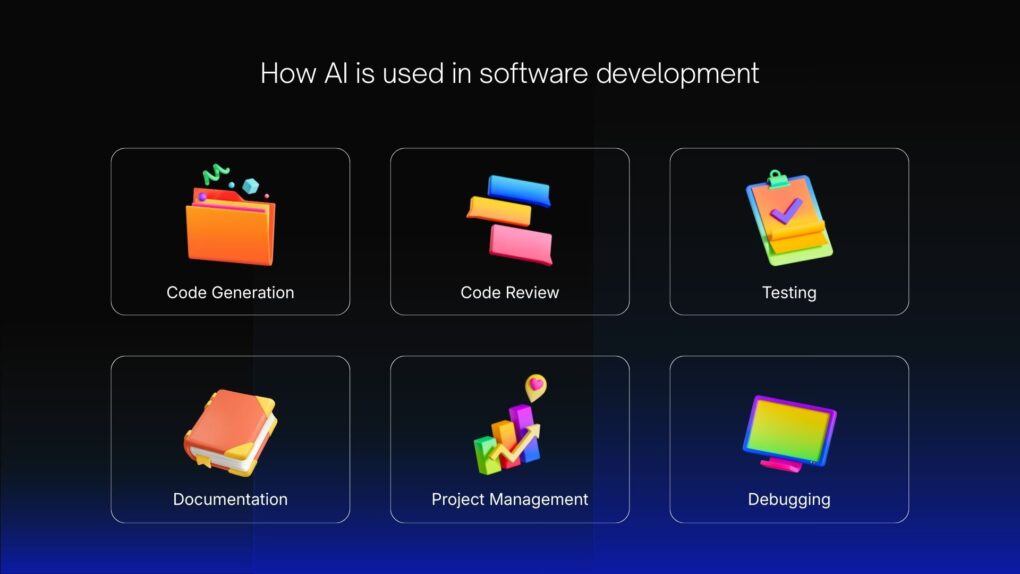
Code Generation
AI acts as a powerful assistant, converting natural language descriptions into functional code. For instance, a simple request for a data validation script can generate production-ready lines complete with error handling. This capability extends to building entire modules or adapting code for different frameworks, significantly reducing the need to start from scratch.
-
Reduces time spent on initial drafting.
-
Accommodates multiple programming languages.
Developers then adjust the results to ensure alignment with existing systems.
Code Review
AI analyzes code, potentially with the help of dependency scanners to catch inefficiencies and security vulnerabilities early. It identifies redundant logic or potential bottlenecks and suggests alternatives based on industry best practices. Advanced models can even spot subtle logical inconsistencies or recommend refactoring to improve long-term maintainability. Combined with dependency scanners, AI can also help detect vulnerable or outdated packages before they introduce larger security risks.
This proactive approach results in cleaner code from the start, reducing the need for constant revisions and strengthening the overall integrity of the codebase.
Testing
AI designs and executes tests by predicting exactly where a system is likely to fail. It simulates real-world user interactions to uncover functional gaps or performance issues. Moreover, AI can sequence tests according to recent modifications, focusing on high-risk areas to streamline the testing process.
-
Encompasses a broader range of scenarios than manual approaches.
-
Modifies tests in response to code alterations.
These outcomes assist in directing repairs effectively, yielding more resilient software.
Documentation
AI automatically generates summaries and technical guides from code annotations and frameworks. It keeps documentation in sync by updating manuals the moment a new feature is deployed. AI can also translate technical docs into multiple languages or create interactive walkthroughs for users. Teams can also enhance these materials with engaging visual assets, such as an AI poster for tutorials, product announcements, and internal guides, or an AI video extender to add more context to video-based documentation.
This saves significant time on manual updates, ensuring teams always have a “single source of truth” and eliminating knowledge gaps.
Tip: Since these docs are often published externally, some teams also check the writing with an AI detector before release to confirm how much of the final text needs a human editing pass.
Project Management
AI analyzes historical data to provide more accurate project timelines. It dynamically adjusts schedules based on team availability and emerging challenges. Additionally, it optimizes resource allocation by matching specific developer skills with the right tasks.
Automated alerts regarding potential setbacks allow for timely adjustments, drastically improving team coordination and delivery speed.
Debugging
AI pinpoints the root cause of errors by scanning logs and recognizing failure patterns. It offers actionable solutions, such as logic adjustments or variable fixes. In complex, distributed environments, AI correlates errors across multiple services to identify the underlying issue.
This accelerates troubleshooting, especially in intricate microservices, and significantly reduces system downtime.
These implementations have made AI a cornerstone of modern workflows. Research indicates that AI integration can accelerate coding tasks by up to 55%.
Exploring the benefits of AI in software development
AI improves software development by optimizing processes and minimizing mistakes. It allows teams to provide value more swiftly while upholding elevated standards. Here is an overview of the primary benefits:
-
Increased speed: AI automates the composition of code and testing, allowing teams to accomplish up to 26% more tasks. This hastens progress toward deadlines without compromising completeness.
-
Improved quality: By identifying concerns early, AI enhances the dependability of code. Investigations reveal that work assisted by AI can achieve 40% superior outcomes.
-
Strengthened collaboration: AI interprets concepts across different positions, enabling individuals without coding expertise to participate meaningfully. This promotes cohesive teams and novel resolutions.
-
Financial savings: Gains in efficiency diminish total expenditures, with possible decreases of up to 30% in development costs through more effective resource utilization.
-
Decreased fatigue: Delegating repetitive duties liberates developers to address inventive challenges, elevating satisfaction and retention.
- Smarter automation: Agentic AI can manage multi-step development tasks independently, reducing manual effort and improving team efficiency.
These merits establish AI as a pivotal influence in the sector.
AI’s role in the software development lifecycle (SDLC)
The SDLC provides the essential framework for turning a concept into operational software. AI brings intelligence to every phase, enabling more accurate decision-making and faster release cycles. This makes the entire development process more adaptable while significantly reducing overall timelines.
Notably, AI drives continuous improvement by learning from previous projects, predicting outcomes, and automating transitions between stages.
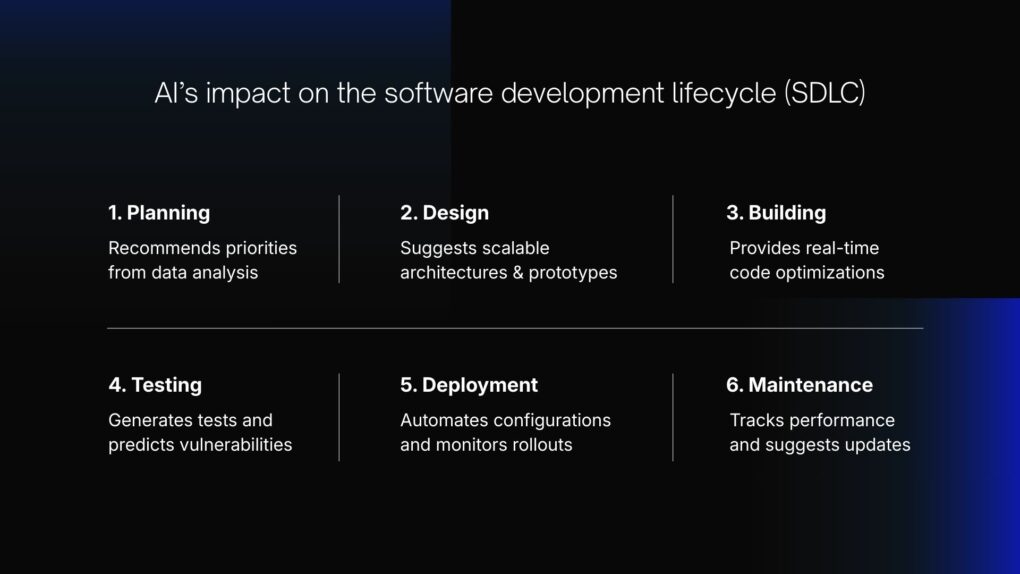
Planning
AI analyzes requirements and user data to suggest priorities. For example, it identifies trending features based on market patterns and aligns them with your goals. It also simulates project scenarios to test feasibility.
This data-driven approach removes guesswork and builds a solid foundation for your project.
Design
AI recommends ideal structures, accounting for expandability and connectivity. It constructs prototypes promptly, enabling teams to appraise alternatives without substantial manual input. AI instruments illustrate designs and confirm adherence to criteria.
Refinements occur in successive iterations, informed by simulated executions.
Building
In the coding phase, AI supplies immediate completions and enhancements. It follows your project’s coding conventions, suggesting the best algorithms and libraries. Integration with version management systems maintains uniform code standards.
This drives higher output across the board, with experienced developers seeing a clear increase in their contribution rates.
Testing
AI builds comprehensive test suites, including edge cases. It runs evaluations to predict vulnerabilities, going beyond traditional methods. Machine learning constantly improves these testing processes.
Continuous feedback loops quickly sharpen code quality.
Deployment
AI oversees the implementation process, automating configurations. It detects anomalies instantly, allowing for quick rollbacks if needed. Predictive maintenance identifies potential deployment risks before they happen.
This ensures a smooth transition to live operations.
Maintenance
Once deployed, AI tracks application performance, and you can also monitor efficiency using an AI burn rate calculator to optimize resource usage and costs. It predicts potential failures based on usage trends and suggests updates to extend the software’s lifespan. Automated log analysis identifies recurring patterns.
Overall, AI can contribute to 10-15% productivity boosts across the lifecycle. It transforms SDLC into a dynamic, efficient framework.
Handling the potential risks of AI in software development
While AI offers substantial capabilities, it also presents challenges that require careful oversight. Issues like inaccurate outputs or ethical concerns can compromise a project if left unaddressed.
Organizations should establish safeguards, including periodic evaluations and training, to align growth with accountability. Data indicate that up to 51% of AI-generated code may contain vulnerabilities, underscoring the need for caution.
-
Inaccuracies: AI might yield flawed code; studies identify defects in nearly half of the productions. Confirm through human assessments and testing procedures.
-
Bias concerns: Imperfections in training data can result in inequitable consequences. Broaden sources and perform equity evaluations to foster fairness.
-
Over-reliance: Excessive dependence erodes skills, as 66% of developers express trust concerns. Encourage ongoing education and manual overrides.
-
Security concerns: AI code often includes flaws like improper validation, affecting 32% of snippets. Use scanning tools and secure prompts. Use scanning tools, secure prompts, and solutions like PowerDMARC to help prevent phishing, spoofing, and domain abuse.
-
Intellectual property queries: Ownership of generated content can spark disputes. Establish clear policies and consult legal experts.
-
Employment transitions: AI may displace roles, with nearly a quarter of organizations anticipating losses. Focus on reskilling for new opportunities like AI oversight.
Addressing these proactively ensures AI’s safe integration.
DevSamurai’s AI tools for software development
DevSamurai enhances Jira with AI tools powered by Rovo Agents. These solutions automate workflows, providing targeted support for agile teams. They integrate seamlessly, offering efficiency without disruption.
Built on Atlassian’s Rovo platform, these agents focus on specific areas like testing, planning, and resource management, helping teams summarize data, generate content, and gain insights directly in Jira. This approach brings AI into familiar tools, reducing context switching and boosting productivity for QA, product, and project managers.
AgileTest: Rovo Agents
AgileTest streamlines testing processes. Its Summary & Analyzer agent aggregates data from test items, delivering insights via natural queries.
The Generator agent crafts test cases from requirements, allowing chats for refinements. This reduces manual work, improving coverage.
ProductGo: AI-Generated Story Map
ProductGo visualizes planning with AI-generated maps. Provide epics, and it structures stories and steps automatically.
TimePlanner: Rovo Agents
TimePlanner, currently in development and set for future release, focuses on generating clear overview reports of task allocation, making workload management simpler.
These offerings boost productivity, with accessible pricing for various team sizes.
The future: Agentic AI in software development
Agentic AI marks a shift to autonomous systems that plan, execute, and adapt independently. In software development, these AI agents could handle full workflows, from code generation to deployment, using multi-agent teams for specialized tasks like testing or security reviews.
By 2026, Gartner predicts 40% of enterprise applications will include such agents, evolving tools from simple assistants to proactive collaborators.
This promises faster innovation, with agents simulating processes to cut errors and time. However, reliability and governance remain key challenges, requiring strong frameworks for transparency. Predictions show 75-90% of engineers using AI assistants by 2028, with agentic systems at the forefront.
As adoption spreads, vertical agents tailored to industries will emerge, fostering AI-native approaches where humans guide strategy and agents manage execution. Starting with pilots in areas like bug fixing can ease the transition to this transformative era.
Final thoughts
AI is set to redefine software development, providing tools that amplify both efficiency and creativity. By embracing these advantages while actively managing the risks, teams can achieve sustainable growth and technical excellence.
As agentic systems materialize, the key to success is deliberate implementation: start small, learn continuously, and prioritize ethics. This balanced strategy will empower your team to build superior software in an ever-evolving digital landscape.