Written by: Amoeboids – Atlassian Marketplace Partner
A customer emails the support team asking why a promised feature still isn’t working.
The support rep checks the ticket. Nothing. They search Jira. Still nothing. They open Confluence. Nothing there either.
Then someone from the engineering team sends a quick reply. “That feature went live two weeks ago.”
Suddenly, everything makes sense. But by then, the customer has already lost confidence, and the support team has lost valuable time.
This scenario is more common than most product teams realise.
The release team went out on schedule. The engineering team considers the release complete. But the sales and support teams often learn about the change from a confused customer, not an internal update.
It’s rarely a case of anyone forgetting to communicate. The real failure sits somewhere between finishing the work and telling the people who need to know.
In this blog, we’ll break down why this keeps happening. We’ll also cover what it costs your business and how to close the gap before customers notice first.
The Core Problem: A Communication Gap, Not a Content Gap
Here’s the part that surprises most people: the information was never missing.
Every detail about what changed already lives in Jira. Every ticket, status update, and closed issue tells the story of what happened.
The problem isn’t that the content doesn’t exist. It’s that the information is trapped inside engineering team workflows instead of reaching the people who need it to talk to customers.
Jira was designed to help teams manage work, not to communicate it outward to non-technical, customer-facing teams. It’s a workspace for builders, not a broadcast tool for the rest of the company.
As a result, release notes and reports remain technically accurate but often never reach sales, support, or other customer-facing teams.
Automated Release Notes & Reports for Jira can help close this gap. It turns the information already in Jira into clear, timely updates for the teams that need it.
Why Sales and Support Get Left Out
No single team causes this problem. Instead, it happens when several small communication gaps combine and prevent release information from reaching customer-facing teams at the right time.
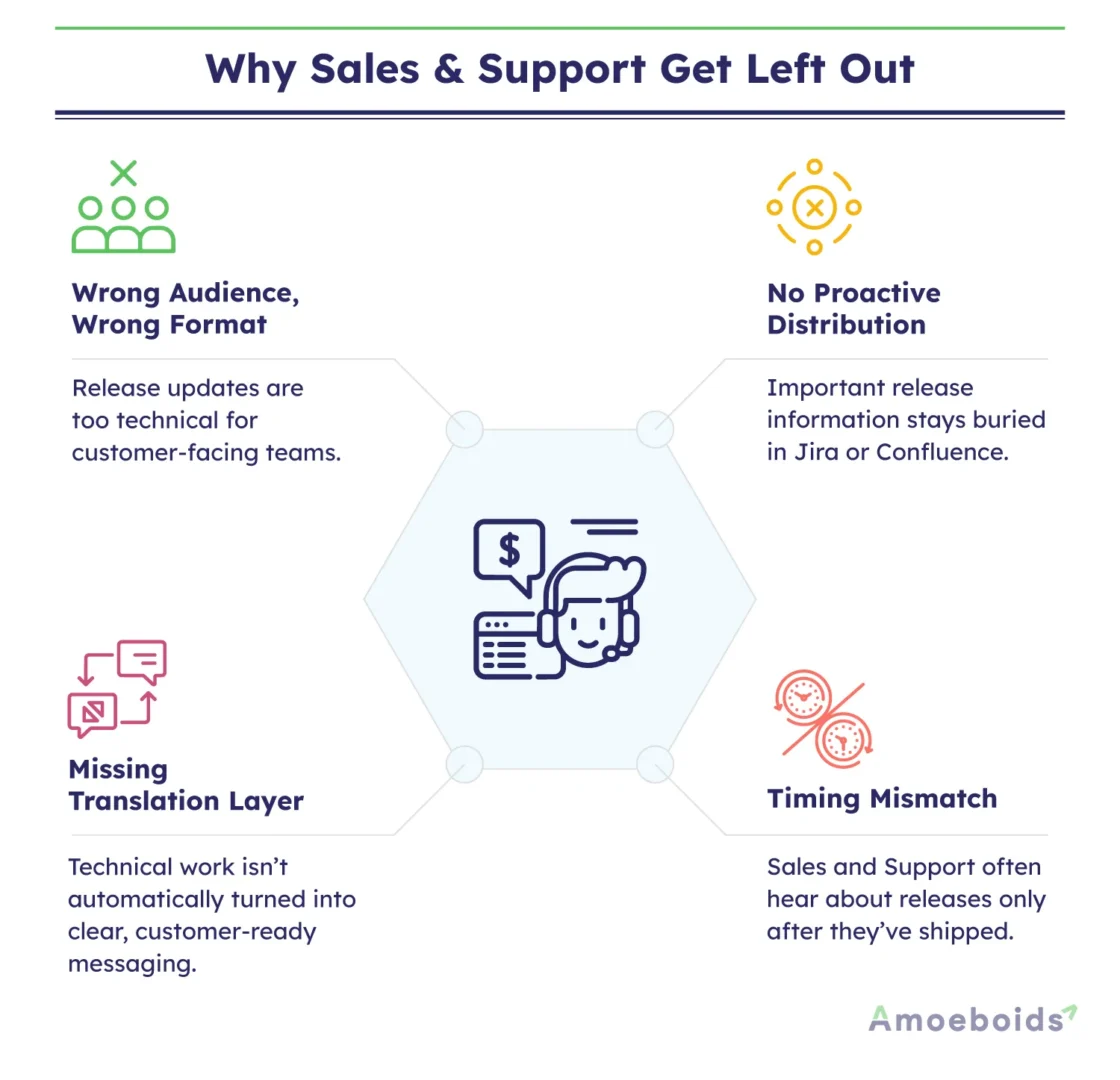
- Wrong audience, wrong format: Release notes and reports are often written for engineers and product managers. They use technical jargon, making it difficult for the sales and support teams to explain changes to customers who require plain-language summaries.
- No proactive distribution: Release notes and reports stay inside Jira or Confluence instead of reaching the right people. Customer-facing teams have to search for them instead of receiving them automatically.
- Timing mismatch: Engineers ship releases on their own schedule, but the sales and support teams rarely learn about them until the next team meeting or a customer conversation.
- Missing translation layer: Jira tracks technical work effectively, but it does not turn issues into audience-ready updates. Technical changes must still be translated into clear and business-friendly communication on a regular basis.
The Upstream Visibility Problem
Sales and support teams rarely see what’s coming next. They don’t have visibility into the roadmap. They have no idea what is already in progress.
Here’s what that looks like in practice.
On Monday, a salesperson is speaking with a potential customer over the phone. The potential customer enquires about a particular feature.
“Not yet,” the salesperson says. “It’s not on our roadmap right now.”
By Friday, the engineering team has already started building the feature. Sales never hears about it. Two weeks later, the feature goes live. The salesperson only discovers it after a customer asks about it.
That’s not a small oversight. That’s a team walking into conversations blind.
Moments like this don’t stay isolated. They ripple outward and start showing up in everyday work.
The Real-World Impact
The biggest impact isn’t on your release. It’s on the people who rely on that information every day. When sales and support teams don’t receive release updates on time, small communication gaps can quickly turn into bigger problems.
- Support teams don’t have the answers: When a customer enquires about a newly released feature, support teams may be unaware that it exists. They spend extra time searching for information or asking the engineering team for help, which delays responses.
- Sales shares outdated information: Without the latest release updates, sales teams may continue talking about old features or miss new ones. This can lead to customer confusion and misaligned expectations.
- Customers discover changes first: Instead of hearing about new features from your team, customers find them on their own. This makes your communication feel reactive rather than planned.
- Teams waste time repeating the same work: Without clear release communication, teams spend time answering the same questions, verifying information, and resolving issues that could have been avoided.
These problems may seem small at first, but they add up quickly. According to McKinsey, employees spend nearly 1.8 hours every day searching for information. That’s almost one full workday every week.
Over time, this affects more than productivity. Teams become frustrated, customers lose confidence, and trust starts to fade.
But these problems are preventable. Once you identify where communication breaks down, you can build a process that keeps everyone informed.
What Sales and Support Actually Need
The solution is not another weekly meeting or Confluence page. Customer-facing teams simply need timely, understandable information delivered where they already work.
- Share updates before release day: Allow customer-facing teams to see upcoming changes before they are released. This allows them to confidently prepare answers, documentation, and customer conversations.
- Automate release communication: Customer-facing teams should receive release updates automatically, without the need for human reminders. Everybody gets the most recent information at the appropriate moment.
- Write for business users, not just engineers: Explain what changed in simple, non-technical language that everyone can understand. Think about the significance of the update rather than just listing technical details.
- Deliver updates where teams already work: Send release notifications automatically via Slack, Microsoft Teams, or email. Customer-facing teams can stay informed without having to use another tool or wiki.
When release communication becomes a part of the workflow, everyone is in sync. This means fewer surprises, faster answers, and a better customer experience.
Closing the Upstream Gap: Visibility Into What’s Coming
Let’s start with the earlier half of the problem: the roadmap blind spot.
Sales and support teams need to see what’s coming before it hits a customer’s screen. ProductGo helps close this gap by giving customer-facing teams visibility into the user story map and work in progress before release day.
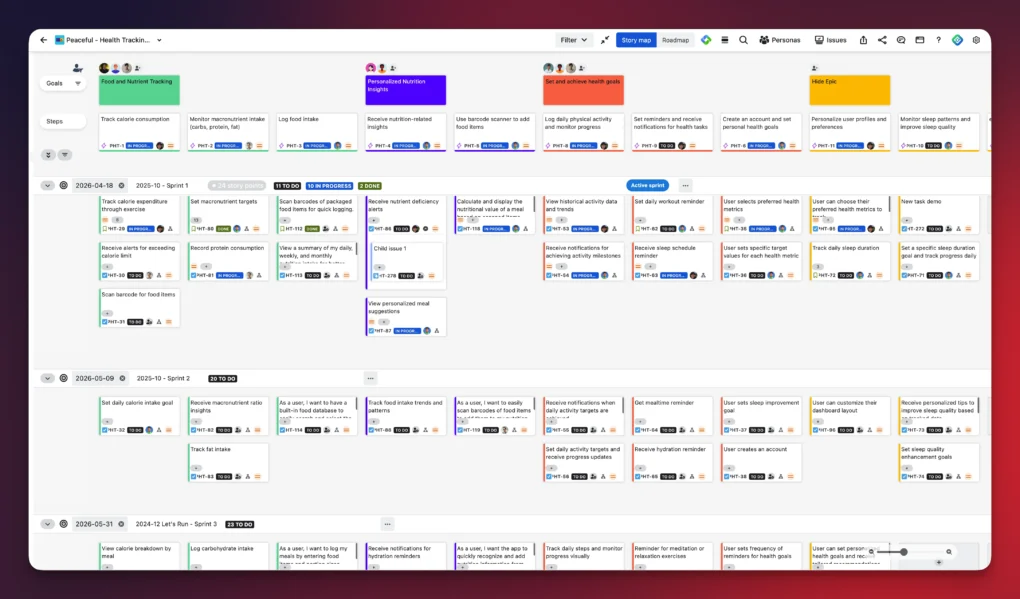
Customer-facing teams can see what’s planned in real time instead of learning about a feature after it launches.
Sales can prepare talking points before release day. Support can prepare answers before questions start arriving in the ticket queue. As a result, everyone is prepared for release day instead of rushing to catch up afterward.
Closing the Downstream Gap: Communicating What Shipped
Once a release goes live, the next challenge is making sure customer-facing teams actually hear about it.
This is where a communication layer within Jira becomes important. That’s exactly what Automated Release Notes & Reports for Jira was built to provide.
The Automated Release Notes & Reports app for Jira pulls directly from Jira issues and releases, so nothing gets left behind or written from memory. It turns technical Jira updates into clear and audience-ready release notes and reports that sales, support, and other stakeholders can quickly understand. The app automatically sends those release updates to Slack, Microsoft Teams, email, or Confluence.
No one has to remember to check a wiki. No one has to manually rewrite a changelog into something a sales rep can use on a call. The update simply arrives, already in the right format, in the right place.
Two Gaps, One Fix
It’s worth pausing here to name something clearly: this isn’t one problem. It’s two.
Sales and support miss releases for two different reasons. They don’t know what’s coming next, and they don’t receive clear communication about what has already shipped. Closing the first gap requires better upstream planning visibility. Closing the second requires automated and audience-ready release communication.
Solve only one, and teams stay half-informed. Fix roadmap visibility without fixing release communication, and support still gets blindsided on launch day. Fix the release notes without fixing the roadmap gap, and sales still walks into calls blind.
Both pieces matter. Neither one works alone.
Conclusion
The difference between sales, support, and the rest of the product organisation isn’t caused by people. Nobody drops the ball on purpose.
It’s a process gap that spans planning and communication alike. Process gaps don’t fix themselves. They need a system built around them.
Companies that improve both roadmap visibility and release communication keep customer-facing teams informed before and after every release.
When the right information reaches the right people at the right time, every customer conversation becomes more confident, consistent, and informed.